Showing posts with label West Toronto Communites. Show all posts

Sunday, May 6, 2012

Toronto Park Summit this coming Saturday May 12th, the junctioneer blog will be posting updates from the event all day

Organized by Park People, on Saturday, May 12 at the Brickworks, starting at 1 p.m. Keynote speaker is Robert Hammond, co-founder of the famed High Line elevated park in Manhattan.

You can attend - Registration is free (and/or PWYC) but space is limited.

Click here to register


Pls remember to uses www.junctioneer.ca to visit this blog.

Artists in the Hood fundraiser for the Town Square

Part proceeds to Wabash Building Society for the Town Square fund.


Wednesday, November 9, 2011

Shocking activity by city council members and staff


The blog wanted to highlight a particularity worrisome point brought out publicly by the  Toronto Public Space  (TPSI) group in their report on unprecedented policies that will allow the city to sell off the names of public spaces and bring in aggressive advertising into them, including parks and playgrounds. (see this post - its below this one)

Yet they are bringing local business Improvement associations (BIA's) into the decision-making and planning activities about these changes. That is right, the local retail store owners across the city are being consulted and allowed into the fold to decide how local parks are named and what advertising will go into them, Yes, big advertisers are involved too and their ads in parks and parkettes are probably not welcome also. But residents and community groups such as residents associations are not part of the consultation process.

"the inclusion of BIAs in a consultation process to the exclusion of all other stakeholders" [1. Toronto Public Space  (TPSI)]

Simply,  1st importance of the what the parks are to the community of people who use them is being removed from the people.

Hopefully the ethical BIA's in Toronto with see the folly of of being associated with this. BIA's are structured and created to improve retail streets and businesses within their areas.


Friday, October 15, 2010

Important Rabble article


Reported here is a important and good article for any person stymied by the  current election issues in Toronto

Reposted from rabble.ca

Moving forward on municipal voting reform in Toronto
LARRY GORDON
OCTOBER 14, 2010

As we enter the final stretch of the Toronto municipal election, two things have become abundantly clear.

First, we need a new and better way of electing our mayor and city councillors. A voting system that forces many people to vote strategically rather than sincerely, and that creates a council not reflecting our city's diversity, has no place in a 21st-century democracy. Second, we need a process to identify the best system or systems for Toronto -- a course being promoted by the Toronto chapter of Fair Vote Canada.

Progressive activists have been fighting for fair and proportional systems, and voter equality, at the federal and provincial levels. Now we need to press for the same at the municipal level. Voter equality is what creates truly representative bodies that reflect the full diversity of the community.

In 1865, Swiss philosopher Ernest Naville summarized the core democratic principles this way: "In democracy the majority has the right of decision, but all have the right to representation." If those principles resonate with Torontonians -- and indeed all Canadians -- then we have to study the systems that deliver the goods.

How do we address those principles? Broadly speaking, there are two types of voting systems: winner-take-all and proportional (or fair) voting systems. Each has its place in a democracy.

When an election is held for a one-person position -- such as a mayor, party leader, president -- a winner-take-all system is needed. Only one candidate can win -- only one person can play the role.

Under the current system in Toronto, the candidate with the most votes wins the mayor's seat. But we could switch to a run-off system, where the winning candidate needs at least 50 per cent plus one to win -- most easily done by using a ranked ballot, where second choices play a role if no candidate has a majority of first-choice votes. Most Torontonians would probably greet the use of instant run-off balloting for the mayor as a step forward.

But with any type of winner-takes-all voting, instant run-off or first-past-the-post, a lot of voters still cast ballots that elect no one.

Fortunately, when voters are electing a city council (or provincial legislature or federal parliament) -- a body with many elected people whose purpose is to represent and act on behalf of all voters -- then we have another option. We can and should use a fair and proportional system, designed to allow almost all voters to elect someone to council. This means that not only do the largest group of voters, or the majority, get to elect councilors, but so will those with minority points of view. For example, progressive voters living in a part of the city dominated by conservatives will be able to elect someone, and vice versa. With a fair and proportional system, you don't lose your right to political representation because of your political views and where you happen to live. And the overall outcome is a council representing the full diversity of the electorate.

The fair voting concept sounds great, but how do you do it at the municipal level?

This is where a citizen-engagement process is needed. We have numerous options and may even want to develop a hybrid system specifically for Toronto.

One option is having larger wards that elect more than one councillor -- that's what allows more than one group of voters to gain representation. Electing two or three councillors in larger wards opens the door to representation for both the majority and minority within a ward. Electing four, five or more in a larger ward gives even better assurance of fair representation for all.

Another approach is a mixed system, which would have the added advantage of creating council positions that are accountable to a citywide base of voters.

For example, rather than 44 small neighbourhood wards, we could have 34 wards and 10 citywide council positions. The 10 citywide positions would be elected by everyone, using a ranked ballot form of proportional representation (called the single transferrable vote), which would allow minorities as small as 10 per cent of all voters in the city to elect a candidate to one of those positions.

Another interesting option: rather than citywide seats, we could divide the city into four districts, each with three or four district council members to represent voters in those areas.

Some say that the only reform we need in council elections is to use ranked ballots (instant run-off voting) to elect the individual councillors from the 44 wards as they exist today. But that winner-take-all voting would still leave too many voters unrepresented -- plus it leaves us with a council composed solely of politicians each elected by a portion of voters in just 1/44th of the city. No one other than the mayor would be democratically accountable to broader groups of voters.

When we have a reform opportunity, let's not just replace the current system, which leaves far too many people unrepresented, with another alternative that also leaves too many people unrepresented. One of the mixed systems described above might be an interesting compromise for those who want to see instant run-off voting in wards and others who want to see the introduction of at least an element of proportional representation. And multi-member wards also deserve serious consideration, which leads to the final point.

Reform opportunities are all too rare. The best choices and trade-offs are not always obvious. A traditional sound-bite political debate by city council is not good enough. Torontonians need to be engaged in a serious and thoughtful assessment of the alternatives, with both city and media support.

The Toronto Chapter of Fair Vote Canada is calling for an official city-managed, citizen-driven, expert-supported engagement process to look at municipal voting system options to identify the best voting system or systems for Toronto. In the coming years, we may have one of those rare opportunities to improve our municipal electoral system, so let's do it right -- by engaging citizens and exploring all options.

Larry Gordon is executive director of Fair Vote Canada and a Toronto resident. See FVC Toronto Chapter Facebook group: Fair Voting in Toronto.

- Posted using BlogPress from my iPhone

Wednesday, November 4, 2009

Interested in Junction house pricing?

[caption id="attachment_5522" align="aligncenter" width="500" caption="Toronto Star article on west Toronto house prices"]Toronto Star article on west Toronto house prices[/caption]

Toronto Star article on west Toronto house prices link (opens in new window)

Below is detailed information for West Toronto.

[caption id="attachment_5523" align="aligncenter" width="495" caption="David Pylyp estate agent' information http://www.eleganthomesinwesttoronto.com/"]David Pylyp estate agent' information[/caption]

Friday, October 30, 2009

Canadian Holiday Train comes to the Junction for the second year in a row.

09_HTlogo_colour


headerlogo small junctioneer


Councillor Bill Saundercook hosted the CPR Railroad and local police in his office today making preparations for the evening  the train visits the Junction. Mr Saundercook spearheaded getting trains here last year moving it here from its downtown stopping place, which took him a number of years. The blog knows he does it for the community but we also think he like the people who attended last year that the  entertainment is great and that the trains are neat too.

about the train...

At each event, the Holiday Train provides a box car stage, a line up of great musical talent and a corporate contribution to the local food bank. The community, in turn, is encouraged to donate food and funds, all of which stays in the community.

This is the 11th year that the Canadian Pacific (CP) Holiday Train has been raising food, money and awareness for food banks in communities across Canada and the U.S. To date, we've helped raise $4 million and 2 million pounds of food with our Holiday Train program.

From the initial partnership with the National Food sharing program this was a new idea formed in 1999.That December, CP began running a freight train decorated with thousands of Christmas lights across Canada, to raise awareness of the issue of hunger prevalent in all communities. In 2001, CP launched a second Holiday Train in the United States.

The Canadian Holiday Train will be in the Junction as part of it's US and | Canadian tour Toronto – December 1st - 6:15 p.m. to 7:15 p.m., 87 Ethel Avenue, adjacent to RONA


Entertainers on the Canadian train include the Odds, an alternative rock bank, bringing their energy and full voiced harmonies to the Holiday Train stage for the first time. They will be joined by Shaun Verrault of the Canadian blues-rock trio Wide Mouth Mason.

CPR Holiday Train Photo Essay of last years visit (opens in new tab)

Monday, October 26, 2009

Solid Waste Division fears your excess recycling

[caption id="attachment_5457" align="aligncenter" width="473" caption="The time study monster "]The timestudy monster [/caption]

It seems a report in the Toronto Star has caused the outing of a  little known rule for collection personal who drive our streets to collect  household recycling.  In an effort to achieve maximum collection efficiency- that is, the amount a team can pick up in a shift, there is a rule that does not allow the flexibility of the driver to pick up any excess recycling.

This action could result in a risk of homeowners choosing not to participate but instead throw their excess recycling or compost into the garbage, a city report states

This information was presented to council in a motion for information request by by Councillor Ootes, seconded by Councillor Stintz

Their motion ends with this paragraph


There should not be a limit placed on the amount of recycling that a homeowner can dispose of at their curbside. There should be a convenient, simple and encouraging program that allows for excess recycling to homeowners when the need does occur.

Full motion jump below.

Thursday, October 22, 2009

Junction area receives no support from the Recreational Infrastructure Canada program

Looking at the list of funded projects for the Recreational Infrastructure Canada program it seems that the Junction will see no benefit from the program although other areas nearby  will.

Maybe what is needed is joint effort of residents in the Junction  to begin to develop plans to seek available funds, by  working with elected members in advance of such offers at the federal and provincial level spelling, out priority needs so when funds are offered the groups can  lobby the members about  known projects.

Before are some example listed in the approved projects.

22-10-2009 11-46-28 AM Recreational Infrastructure  Canada Program  in Ontario site link
Tuesday, September 29, 2009

Toronto Star Article -Dundas West businesses between Dovercourt Rd. and Lansdowne Ave. fight to save parking spots

from the story...

Businesses on Dundas St. West say they will consider their legal options if Toronto City Council votes this week to eliminate rush-hour parking and cut other round-the-clock spots on their street between Dovercourt Rd. and Lansdowne Ave.

The city plan, which would also put pay-and-display parking on side streets and eliminate 51 permit-parking spots will devastate some small businesses, according to the Dundas West Business Improvement Area.

"It's difficult enough to run a live music venue – we're just worried this will put us over the edge," said Tracy Jenkins, general manager of Lula Lounge. "I really don't know if we could survive. We're already struggling with the economic downturn."

The city has justified its decision based on a TTC study that compared traffic flow in March 2006 to the same month in 2008, said Sylvia Fernandez, head of the BIA

complete story at the Toronto Star, {opens in new window}

Sunday, August 9, 2009

Toronto's out-of-bounds attractions [Toronto Star article]


The star has a article about closed public spaces in the city, it presents a view fully endorsed by this blog.

Despite the triumph of Doors Open, there are important spaces that are off limits in Toronto – architecture created for the public that is, unfathomably, locked up tight.


from the article...

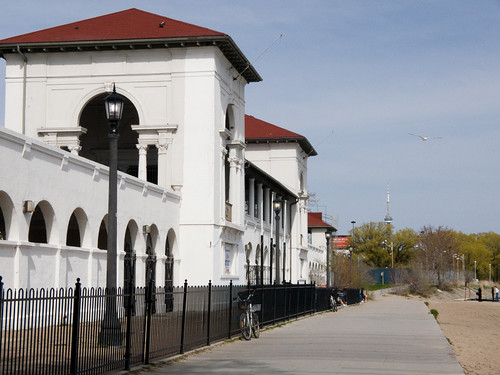
The Sunnyside Bathing Pavilion says as much about the Toronto of today as of yesterday.

Built in the early 1920s, this once-marvellous lakeshore structure speaks of a time when swimming in public still entailed some modesty, not to mention formality. With its fortress-like walls and neo-classical architecture, it evokes a sense of grandeur; swimming here was not simply fun, it was ennobling.

Keep in mind that this was the place where men and women went to change into their bathing costumes, not where they went to swim. It was also a place to enjoy the scenery, read a newspaper and meet friends.

Today, it is a shadow of its former self. Semi-renovated, half-closed, it remains clearly popular. But there's a tackiness to the pavilion now that belies its builders' intentions. On a sunny evening, the café is full of Torontonians enjoying hotdogs and beer. Beach volleyballers fill the space between the building and Lake Ontario.

Look a little more closely, however, and the pavilion reveals itself as a warren of locked doors, chained gates, closed stairwells and unused spaces. Worst of all, what might be the most attractive feature of the complex, the raised balcony level that wraps around the complex, is closed. link to full article

Wednesday, August 5, 2009

Cyclists licensing and mandatory helmets on the horizon?

Councillor Walker,

seconded by Councillor Hall

•


Councillors Walker, and Hall have put forth motions to will require licensing and mandatory helmets in the City of  Toronto is they are approved.


Excepts from the motions....


Councillor Walker, seconded by Councillor Hall, recommends that:


1. City Council enact a by-law to mandate that all cyclists must wear helmets on roads

and sidewalks in the City of Toronto.


Summary


Recently, City Council has prioritized the user groups in public space and public roads within

the City of Toronto. The four groups are prioritized as follows: 1) pedestrians; 2) cyclists; 3)

transit riders; and lastly, 4) vehicle drivers.


Since cyclists are now considered as priority #2 on the public highway, it is being modified to

accommodate these cyclists. Accordingly, with more space on our roads being given over to

cyclists, more rights are being given over to cyclists, and with increased rights come increased

responsibility. Cyclists need to be made aware of this increased responsibility for safe use of

our roads.


Safe use of our roads must include the safety of the cyclists themselves; cyclists must be

protected against the foreseeable dangers on our roads. Conflict between cyclists, cars and most

particularly trucks, and as well conflict between cyclists themselves, create potentially

dangerous conditions. A collision between a cyclist and a car or truck can result in life-altering

injuries or death, particularly for the cyclist involved. A collision between a cyclist and another

cyclist can also result in a serious outcome, if not from the impact itself, then because of the

cyclists falling into oncoming vehicular traffic which results in another collision. It is not at all

rare for a cyclist to experience a disabling head injury from a collision and for that cyclist to

become incapacitated and not be able to provide for his or her family.

2


Cyclists have equipment at their disposal to increase their safety, such as sounding bells,

reflectors, lights and helmets. By far, the most important safety equipment to the cyclist is the helmet.


Councillor Walker, seconded by Councillor Hall, recommends that:


1. The Executive Director, Municipal Licensing and Standards develop a cyclist licensing

program, in consultation with the Ontario Ministry of Transportation, to be brought

forward to City Council.


Recently, City Council prioritized the user groups in public space and public roads within the

City of Toronto. The four groups are prioritized as follows: 1) pedestrians; 2) cyclists;

3) transit riders; and lastly, 4) vehicle drivers.


Accordingly, with more space on roads being shared with cyclists, there is an increased

responsibility to ensure public safety for cyclists. Cyclists need to be made aware of this

increased responsibility for safe use of our roads. Also, City Council needs to put in place a

system to adequately regulate cyclists in a manner commensurate with their increased rights

and responsibilities.


Bicycle Operator/Cyclist licensing is a method of increasing awareness of the existing rules and

regulations applicable to cyclists, such as the Highway Traffic Act. Also, licensing provides for

a formalized relationship between the City and cyclists which the City can use to promote safe

use of bicycles, highlighting requirements for mandatory bicycle equipment such as soundingbells,

reflectors and lights. Furthermore, licensing would provide for more effective

enforcement of the applicable laws and clarify collision situations. Currently, there is not a

requirement for a cyclist to carry personal identification so it is difficult for Police or citizens to

manage collisions between pedestrians, cyclists and drivers due to the fact that a cyclist can just

walk away from the incident; this is particularly troubling if the cyclist is at fault. Also, it is

difficult for a Police officer to give a ticket for a moving violation of the Highway Traffic Act

to a cyclist who is not required to have personal identification on their person and therefore few

tickets are issued.


Thursday, June 25, 2009

City Council - Light Rail Vehicles meeting today and a great background post about the issue at stevemunro.ca

Over at stevemunro.ca a blog about transit and politics there is a great post about

How Many Streetcars Do We Need?


an excerpt...

Recent comments by Adam Giambrone, Chair of the TTC, suggest that 30 to 40 percent of the streetcar fleet is out of service in the shops, and that bus substitution will be required on some routes come the fall.

Those of us who follow the TTC have been waiting for a definitive fleet plan for some time, and hope to see one, finally, in the July Commission Meeting Agenda.  [link to full post]

Info on the city meeting about the issue today.

City Council Agenda - Meeting 37 (Notice of Meeting)

  • CC37.1 - report (June 25, 2009) from the City Manager and the Deputy City Manager and Chief Financial Officer, headed “Purchase of 204 Light Rail Vehicles (LRVs) - TTC Capital Funding”
    Background Information
    Report

Sunday, June 21, 2009

Parks, Forestry and Recreation, to market naming rights and other private funding arrangements

[caption id="" align="alignnone" width="500" caption="Grenadier Pond"][/caption]

The  city auditor general is recommending

7. The City Manager, in consultation with the General Manager, Parks, Forestry and Recreation and the Director, Toronto Office of Partnerships, develop, for approval by Council, a comprehensive City-wide policy on naming rights and other private funding arrangements, such policy to


a. consider all existing policies related to


i. Parks and Recreation Naming and Renaming Policy
ii. Donations policy
iii. Advertising
iv. Unsolicited bids
v. Sponsorships and partnerships


b. include guidelines on


i. eligibility criteria for facilities to be considered for naming rights
ii. responsibility and control processes for securing and accepting naming
rights or other private funding arrangements
iii. the creation of endowment, or similar funds, to offset future
maintenance and repair costs for new facilities put in place under this
policy.


8. The Director, Toronto Office of Partnerships, in consultation with appropriate divisional staff, identify all potential projects and facilities that may benefit from  naming rights or other private funding arrangements and, with the approva
l of Council, pursue such funding according to corporate guidelines.

staff report [link]

Thursday, June 18, 2009

Rogers Structures program segment - Humberside Collegiate Institute


[email_link]


The  Rogers Structures program will be airing,  episodes which feature , Humberside Collegiate Institute and  other west end realated content  , and will be airing on Cable 10 & 63 in Toronto:

Today   3:00 PM

Explore Toronto's history and architecture with host Colleen Walsh. Featuring Islington Village.

The Humberside Collegiate Institute segment will air

Thursday, June 18 @ 8:30pm
Friday, June 19 @ 10:30am
Sunday, June 21 @ 11:30pm
Monday, June 22 @ 8am
Thursday, June 24 @ 3pm


Other Upcoming Episodes dates

Week of June 22nd - Corktown, Humberside C.I., Thistletown Week of July 13th - Thistletown, Humberside C.I. & Corktown

Week of July 20th - The Annex
Week of Aug 3rd - Thistletown, Humberside C.I. & Corktown
Week of Aug 24th - Thistletown, Humberside C.I. & Corktown
Week of Sept 7th - Theodore Heintzman & Central Technical School
Week of Sept 14th - Thistletown, Humberside C.I. & Corktown
All scheduled programs are subject to change.
About the program from Rogers site
Structures is the award-winning television series that has captured the attention of people young and old right across Ontario! Focusing on Toronto's dynamic historical buildings, legends and personalities, Structuresbrings you compelling stories about our local culture and heritage. If you're new to Structures, sit back, relax and enjoy a ride back in time.
Post submitted by David W.     ....who has also informed that the show "Structures" has been cancelled, which will result in no more episodes being created.
[email_link]

Wednesday, June 17, 2009

West Toronto Railpath Opening Parade Saturday, June 20, 2009

[caption id="attachment_4445" align="aligncenter" width="343" caption="Click image to download 8.5 x 11 page version"]railpath_event2009_poster[/caption]


A ribbon-cutting and community bike parade to celebrate the opening of the West Toronto Railpath. Come and discover the new path. For info or to get involved email railpathopening@gmail.com


Presented by:
Friends of the West Toronto Railpath
Date: Saturday, June 20, 2009
Start time: 02:00 PM End time: 03:30 PM
Rain date:


Location:
Wallace Avenue east of Symington at the entrance to the West Toronto Railpath. Under the pedestrian bridge.
Web site: www.railpath.ca
On-site food or beverages Kid-friendly Bike racks

Each and every day multiple hours I miss Matt and Nate

 He’s really does not answer my questions about Matt and Nate, No way, they know the truth